Freehand vs Stencil Polynesian Tattoos — Why I Draw Straight Onto the Body
I'm Amz, a Fijian tattoo artist at Memento in Newtown, and I draw most of my Polynesian work freehand — straight onto the skin. Here's what that actually means, why it flows with your body, and how it changes the piece you walk out with.
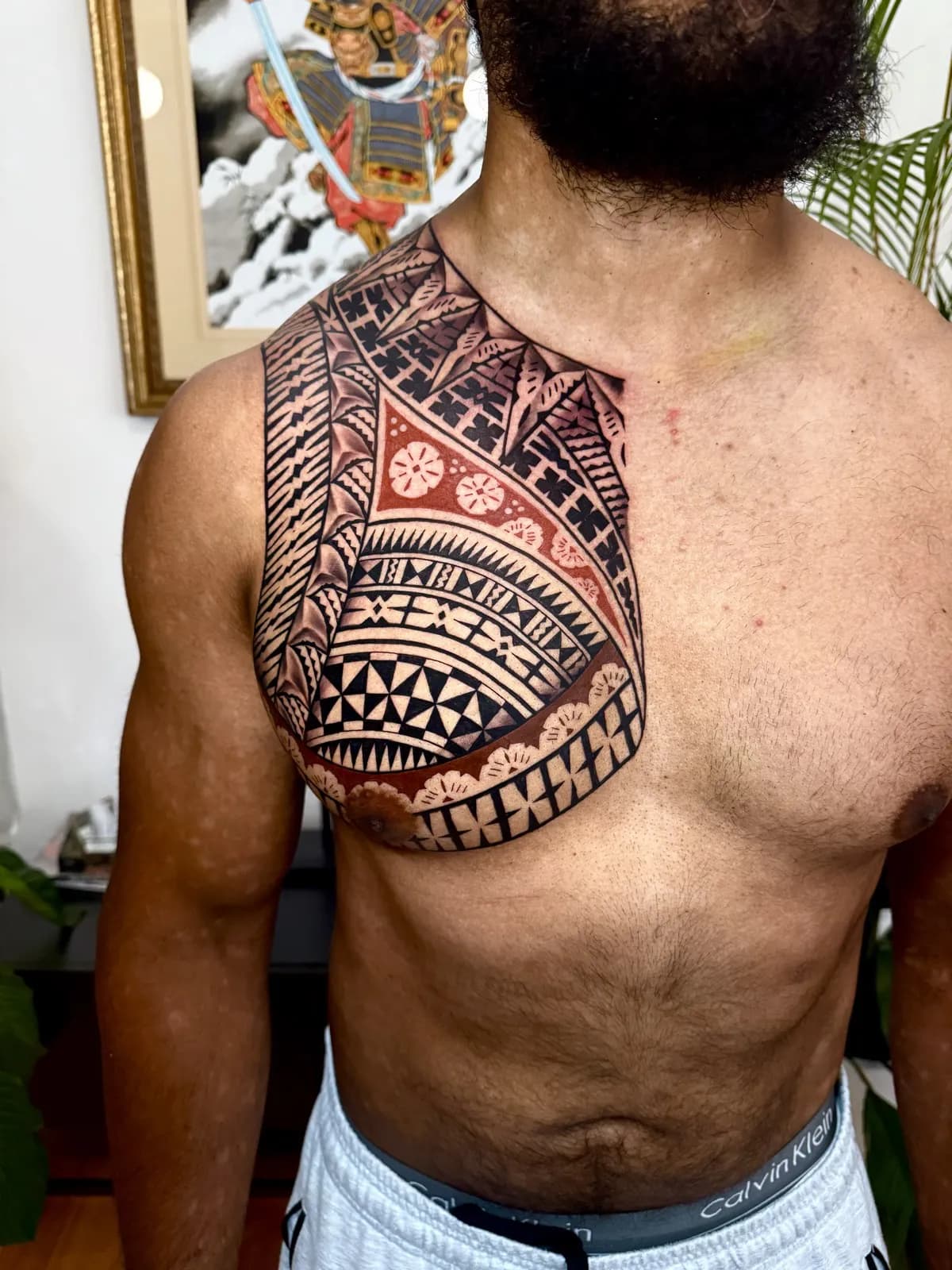
I work on a lot of Polynesian and Fijian pieces at Memento in Newtown, and one of the first questions people ask when they sit down with me is some version of: "So you'll print the design out and stick it on, right?"
Most of the time, no. For Polynesian work I draw straight onto the body.
That choice surprises people, so I want to explain what it actually means, why I do it, and — honestly — when I don't. Because freehand isn't a gimmick or a flex. It's the difference between a tattoo that's on your arm and a tattoo that belongs to your arm.
What freehand actually means
Freehand means I design the tattoo directly on your skin, in marker, before any needle touches you. No printed stencil, no transfer paper. I look at your arm, your shoulder, your calf — the real thing in front of me — and I map the patterns onto it by hand.
A stencil works the other way around. The design gets drawn (or pulled from flash), printed onto transfer paper, and pressed onto your skin like a temporary tattoo. The artist then traces those purple lines with the machine. It's a flat plan, applied to a curved surface.
For a lot of styles that's completely fine. But Polynesian tattooing was never built on a flat page. The old work was read on the body, moving, in the light. So that's where I design it.
A stencil is a flat plan applied to a curved surface. Your body isn't flat, and Polynesian patterns were never meant to be.
How freehand flows with your body
Here's the thing nobody tells you: no two arms are the same. Your deltoid sits differently to the next person's. Your forearm tapers its own way. The bicep line where a sleeve transitions is unique to you.
When I draw freehand, I'm not fighting any of that — I'm using it.
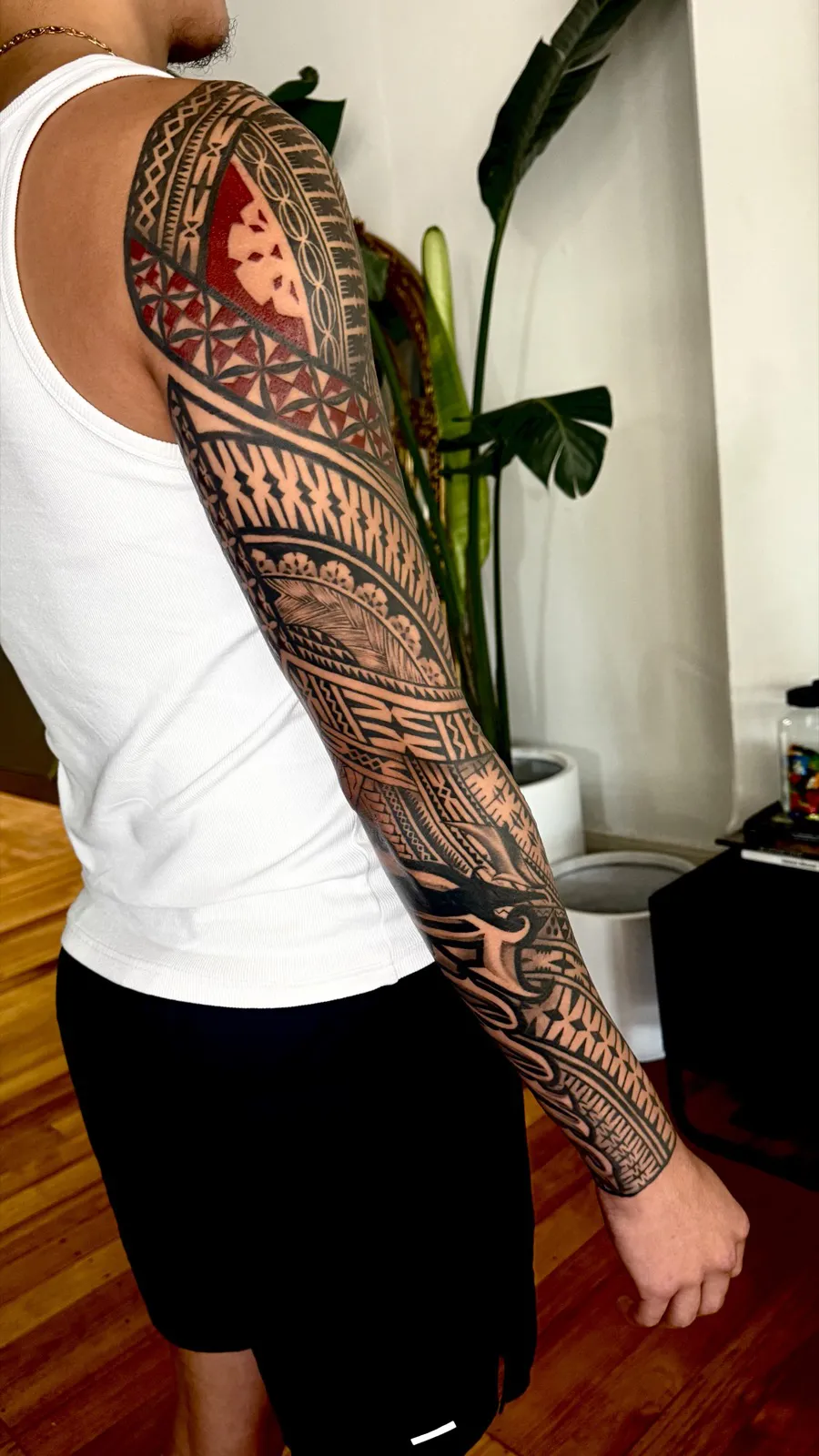
In Polynesian design the layout isn't decoration sitting on top of you. The patterns are meant to follow the body:
- Bands wrap the natural lines of the muscle, so they sit straight when your arm is relaxed and stretch cleanly when you flex.
- Negative space (the skin I leave bare) gets placed where your anatomy already creates shape — over the curve of a shoulder, along the ridge of the forearm.
- Flow lines carry the eye from one section to the next, around the limb, so the piece reads as one continuous story instead of separate stamps.
You can't get that off a printout. A stencil locks the design to one position. The second you move, the flat plan and the round arm disagree. I've lost count of how many cover-ups and reworks I've done where the original problem was simply that — a good design, mapped wrong, because it was planned on paper and never tested on the actual body.
With freehand, I draw it, then you stand up and move. Flex, relax, raise your arm, check the mirror. If a band breaks awkwardly when you bend your elbow, I see it right there and redraw before it's permanent. The skin is the proof.
Freehand vs stencil — what it changes for you
I'm not anti-stencil. Let me be straight about that, because honesty matters more than selling you on one method.
A stencil is the right tool when:
- It's fine-line lettering or a script — precision and symmetry matter more than flow.
- It's a small, self-contained motif on a flat panel of skin.
- It's a design that genuinely needs to be identical left-to-right, like some geometric work.
Freehand is the right tool when:
- The piece wraps a limb and has to flow as one (sleeves, half-sleeves, shoulder-to-chest).
- It's custom Polynesian, Fijian or Pacific-island work, where the patterns are meant to live on the body's movement.
- You want something that fits you specifically, not a design that exists on paper and gets borrowed onto your skin.
For the kind of work I specialise in, freehand wins almost every time. Here's what it changes for you as the person getting it:
You see it on yourself before it's real. The drawing in marker is the preview. You don't approve a flat image and hope it translates — you look at it on your own arm, move with it, and we adjust until it's right.
It fits your body, not a template. The patterns are placed for your muscle and bone, so the piece looks intentional whether your arm is relaxed or flexed.
It's genuinely one-of-one. Even if two people asked me for "a Fijian half-sleeve with similar elements," they'd walk out with different tattoos, because they have different arms. That's not a marketing line — it's just how drawing on the body works.
Now the honest part people actually want to know — money. The tattooing itself costs the same either way. Sydney studio rates generally sit around $180–$250 an hour, and a custom half-sleeve commonly lands somewhere in the four-figure range over a few sessions, depending on size and detail. What you're really paying for with custom freehand is the design time — the consult, the planning, and the drawing on the day. Flash or a ready-made stencil is cheaper precisely because that design work is already done and recycled. A freehand piece is built for you from nothing. I'd rather tell you that plainly than pretend a custom Pacific-island sleeve costs the same as picking something off a wall. If you want the full picture on how I build a piece from scratch, I've written about how custom tattoo design works too.
Tip
What the consultation maps out before any needle
Because I'm not working from a pre-made design, the consultation does a lot of heavy lifting. This is where the piece really starts. It's free, and we can do it by phone, video, or in person at the studio on King Street in Newtown.
Here's what we actually figure out together:
- Placement and scope. Where on the body, how far it wraps, where it starts and stops. We talk about your work, your lifestyle, how visible you want it.
- The elements and what they mean to you. For Fijian and Polynesian work this matters. I want to understand the story you're carrying — family, where you're from, what you're marking — so the patterns I choose are right for you, not generic filler.
- Flow and direction. Which way the piece moves around the limb, how sections connect, where the bold blackwork sits against open skin.
- Sessions and a realistic plan. A bigger freehand piece is built over a few sittings. I'll lay out roughly how many, so you can plan your time and budget without surprises.
- Your reference, my read. You bring inspiration; I'll be honest about what'll age well, what'll flow on your body, and what I'd adjust. That conversation is half the job.
Then on the day, we don't dive straight in. I draw the design on your skin, you move with it, we refine it together, and only when you're genuinely happy do we start tattooing. Nothing permanent happens until you've seen it on your own body.
That's the whole reason I work this way. A printout can't feel your shoulder. I can.
Come in for a consult
If you're thinking about a Polynesian, Fijian or Pacific-island piece and you want it to actually fit you — your body, your story — that starts with a conversation, not a needle.
I offer a free consultation by phone, video, or in person at Memento, Level 5, 292 King Street, Newtown. No pressure, no commitment. We'll talk through your idea, I'll be straight with you about what works, and if it feels right, we'll plan it from there.
Book a free consult whenever you're ready — or have a read through my Polynesian work and Fijian pieces first. Either way, I'd love to hear what you're carrying.
— Amz
Common questions
Answered before you ask
- Is a freehand Polynesian tattoo better than a stencil one?
- For Polynesian work, freehand usually flows better with your body because the design is mapped to your actual muscle and bone, not a flat printout. A stencil can be perfect for clean lettering or a symmetrical motif on a flat panel of skin, but for a piece that has to wrap a shoulder, calf or forearm and read as one continuous flow, drawing straight onto the skin is what makes it sit right. It's less about "better" and more about the right tool for the job.
- Does a freehand tattoo cost more than a stencil tattoo?
- The tattooing itself costs the same — Sydney studio rates generally sit around $180–$250 an hour. What you're paying for with freehand is the custom design time. Flash or a pre-drawn stencil is cheaper because that design work is already done. A freehand Polynesian piece is built for you from scratch, so the consult and the on-skin drawing are part of the value. I quote that honestly up front so there are no surprises.
- How long does drawing a freehand design onto the skin take?
- For a sleeve or a larger panel I'll usually spend anywhere from 45 minutes to a couple of hours drawing on the body before any needle touches you. We're not rushing it — that on-skin drawing is where the piece is actually designed. You'll stand up, move, check it in the mirror, and we adjust until the flow is right. Only then do we start tattooing.
- Can I see the design before you tattoo a freehand piece?
- Yes, always. With freehand the "proof" is the drawing on your skin in marker. Nothing permanent happens until you've seen it on your own body, moved around with it, and you're happy. If something doesn't sit right we wipe it and redraw. You're never committing to a design you haven't seen on yourself first.