Polynesian Half Sleeves & Forearm Bands: Designs, Placement & Real Work
Forearm bands and half sleeves are the work I do most. Here's how I approach placement, what fits where, real healed pieces, and how a Polynesian sleeve gets built across sessions in Newtown.
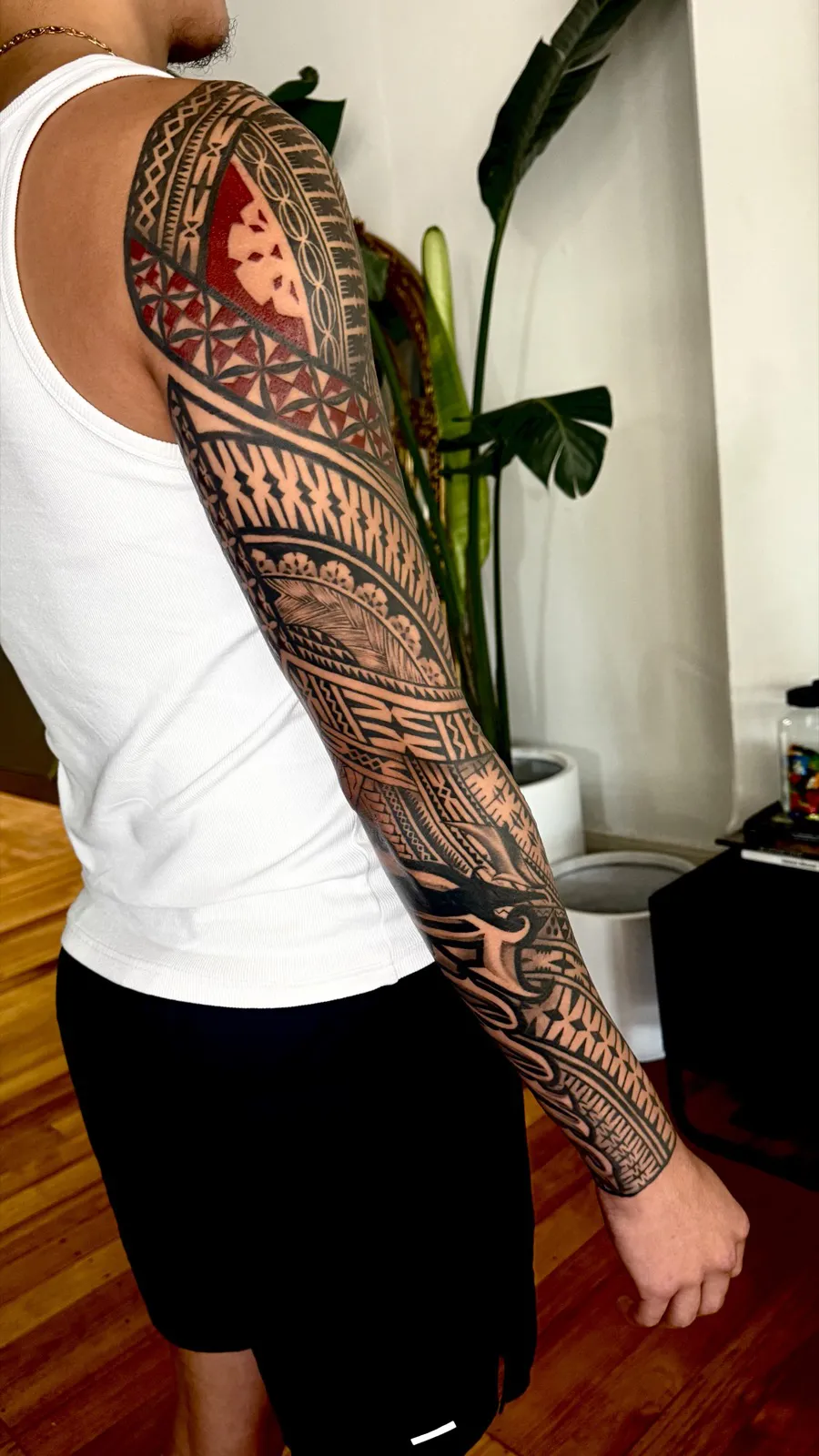
I get asked for half sleeves more than almost anything else. Someone walks into Memento, rolls up a sleeve, and says "I want this whole forearm done, Polynesian, something that flows." And the first thing I do — before we talk symbols, before we talk price — is look at how the arm actually moves.
Because that's the part most people don't think about. A Polynesian piece isn't a print you slap on skin. It's built to live on a body that bends, flexes, and turns. Get the placement and the flow right and the tattoo looks alive for the rest of your life. Get it wrong and it fights your anatomy from day one.
I work on a lot of Polynesian and Fijian pieces at the studio, and forearm bands and half sleeves are the bread and butter of that. So here's how I actually approach them — placement, what fits where, real healed work, and how a sleeve gets built across sessions.
Why placement matters more than the design
Traditional Pacific tattooing was never random. The bands followed the body — wrapping the contours of the arm, the shoulder, the calf — because the form is part of the meaning. I hold onto that. When I design a Polynesian piece, I'm reading your arm like a map before I draw a single line.
A Polynesian tattoo should look like it grew on you, not like it was printed on. That comes from designing to the body, not just onto it.
Here's what that means in practice:
- The forearm tapers. It's wider at the elbow, narrower at the wrist. A band that doesn't account for that taper looks lopsided. I scale the pattern down as it travels toward the wrist so the rhythm stays even.
- The bicep and shoulder are curved. Flowing ocean and banding work beautifully here because the curve carries the eye. This is where I'll often place a sun or a high point — the part of the design that reaches upward.
- The inner arm stretches. The skin on the inside of your arm moves a lot. Dense, fine detail there will distort over time, so I keep that zone simpler and let the bold outer banding do the heavy lifting.
A lot of my Polynesian work is drawn freehand on the skin, or at least heavily adjusted on the body before we commit. I'll map the major bands directly onto your arm with a marker, get you to flex and rotate, and check it from every angle. Stencils are great for symmetry, but Pacific banding needs to wrap and breathe — and you only really see that on the actual arm.
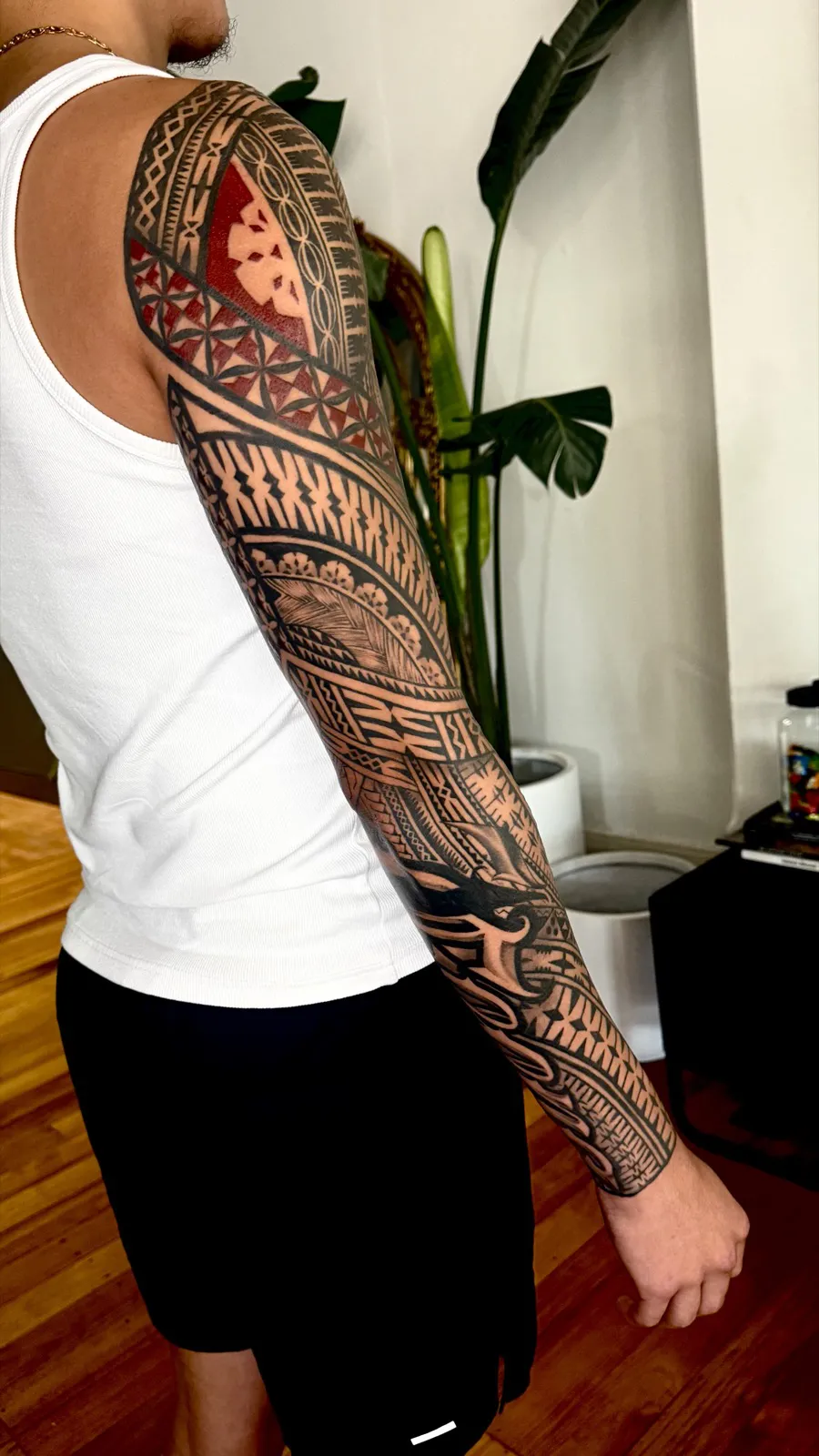
Forearm band vs half sleeve vs full sleeve — what actually fits
These three get used interchangeably, but they're genuinely different commitments — in space, in time, and in cost. Here's how I break it down.
The forearm band
A band wraps the forearm — usually a defined section, not the whole arm. Think a cuff of geometric pattern, shark teeth (niho mano), spearheads, and ocean banding running around the arm. It's bold, it's visible, and it's the most common first step into Polynesian work.
- Best for: a first significant piece, or building toward a sleeve later
- Real talk: the forearm is on show all the time, so it's a confident choice — but it's also a place that gets sun, so look after it (more on that below)
- Sessions: often one solid session, sometimes two
The half sleeve
A half sleeve covers either shoulder-to-elbow (upper) or elbow-to-wrist (lower). This is the sweet spot for a lot of people — enough canvas to tell a real story, without committing the whole arm straight away.
- Best for: someone who wants a proper composition with direction and flow
- Why it works: there's room for the design to go somewhere — ocean at the base, banding and symbols rising through it, a focal point up top
- Sessions: typically 2 to 4, depending on density and detail
Tip
If you think you might want a full sleeve eventually, tell me at the consult. I'll design your half sleeve with that future in mind — so the bands and flow can extend cleanly later instead of looking like two tattoos stitched together. Planning the whole arm up front, even if you ink it in stages, is always better than retrofitting.
The full sleeve
Shoulder to wrist, the whole arm as one piece. This is the most rewarding Polynesian work I do, because the banding becomes connective tissue — it carries your eye the entire length of the arm and the whole thing reads as one journey.
- Best for: someone fully committed to the style, often with deep meaning behind it
- Sessions: usually 4 to 8+, spread over months
Real healed work
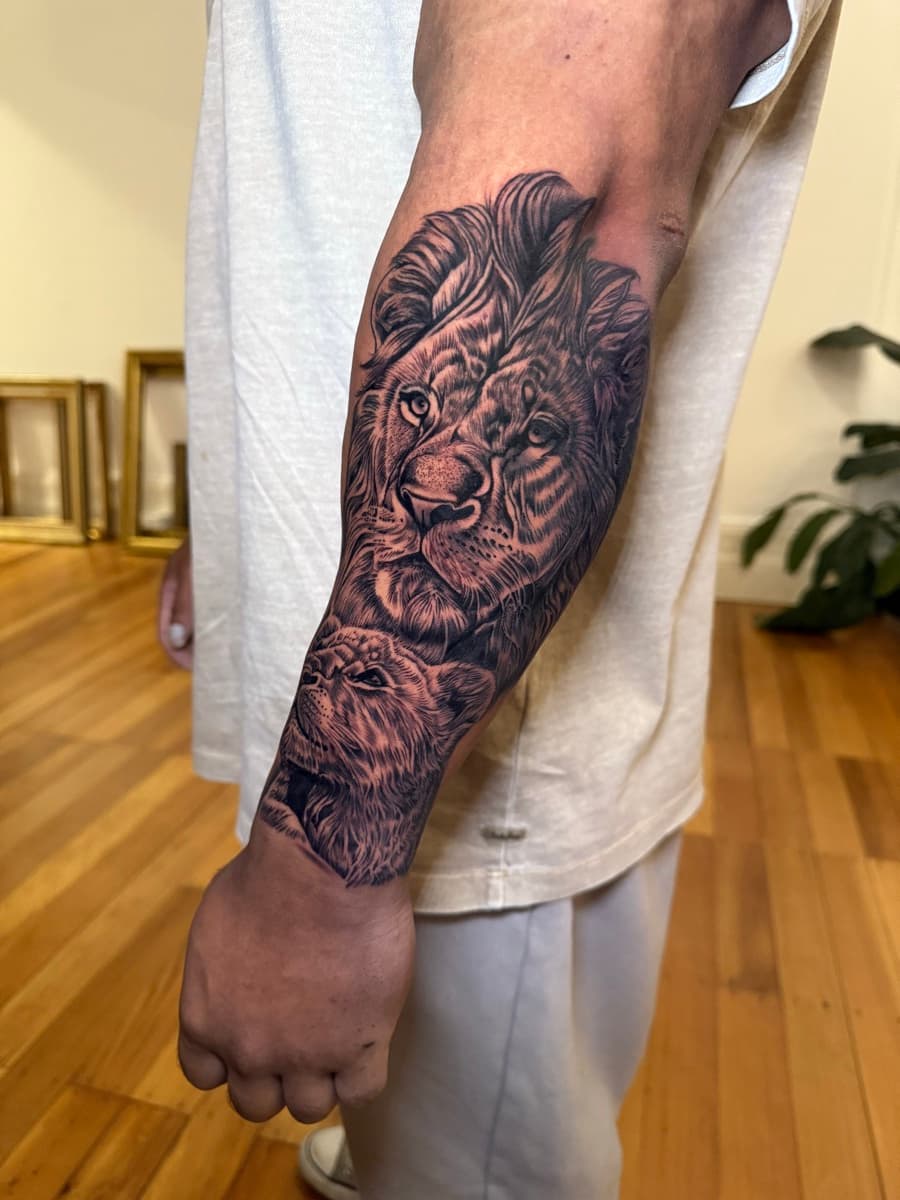
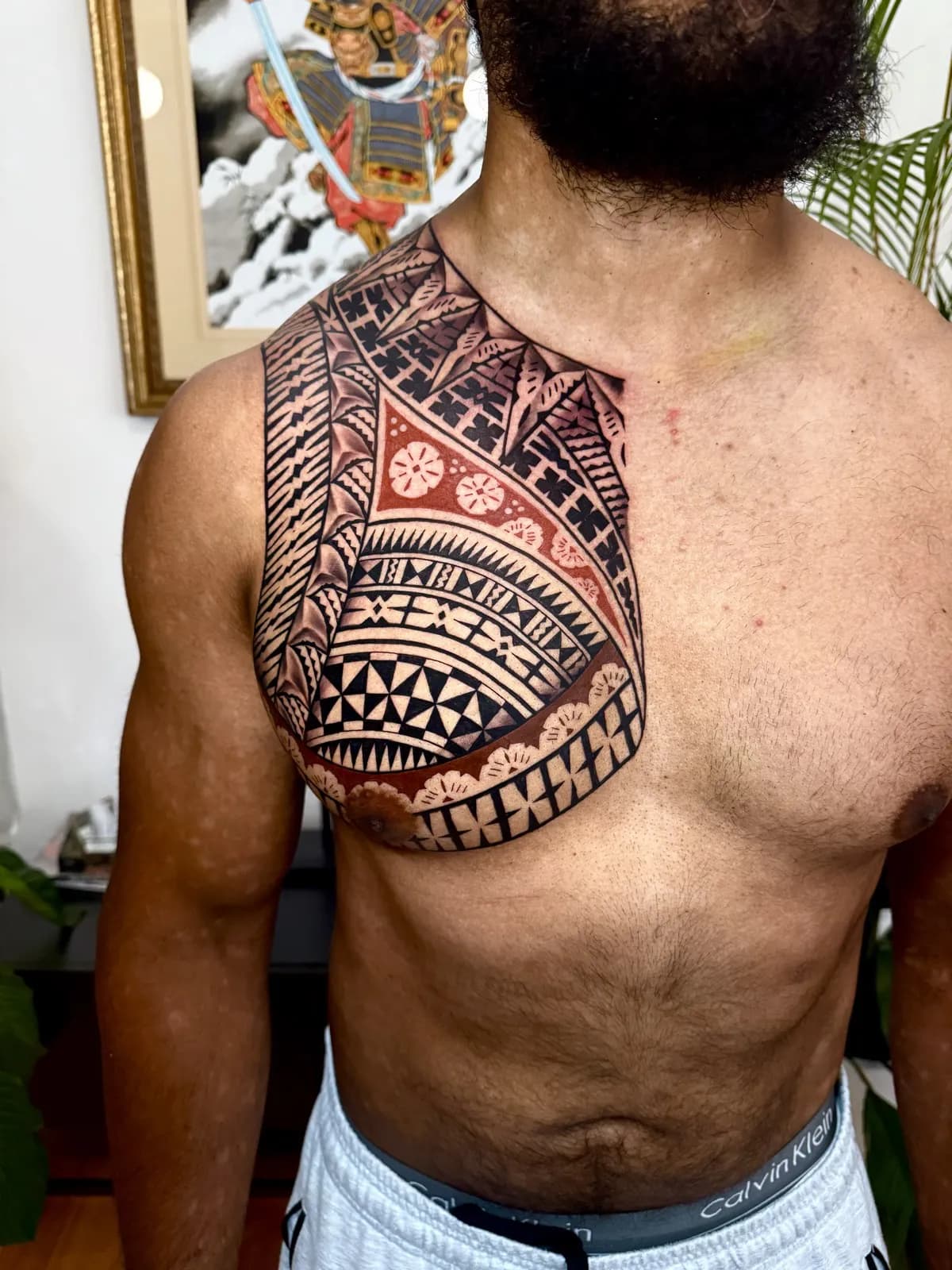
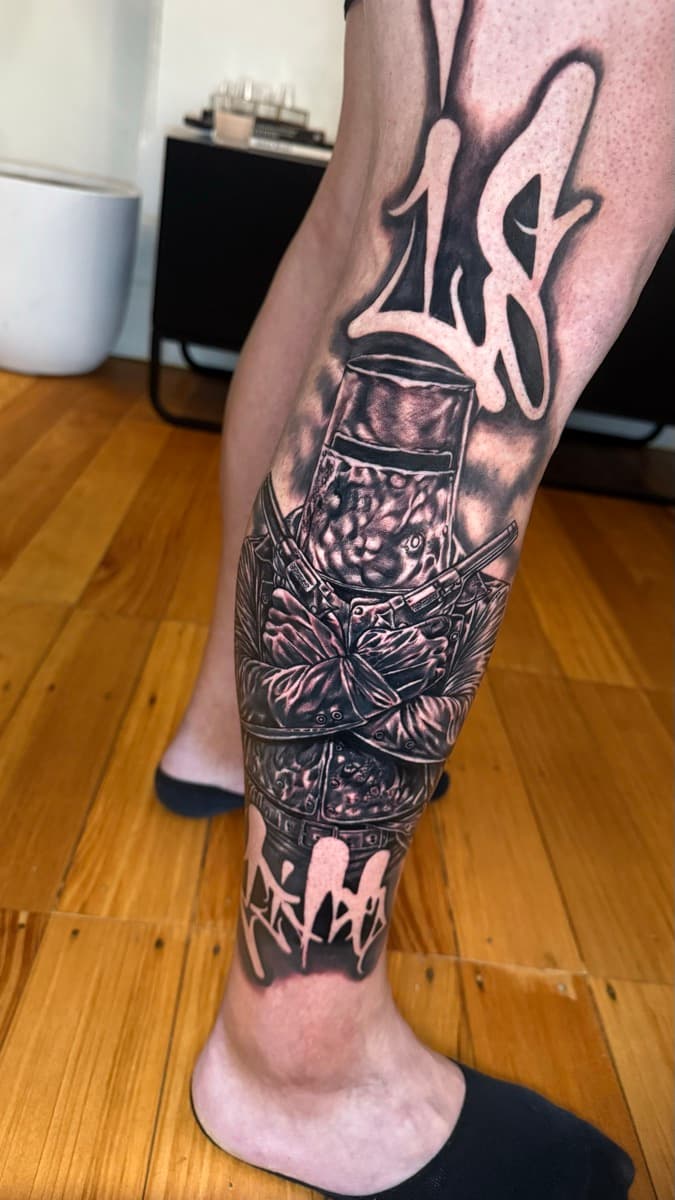
I'd rather show you actual healed pieces off my own arm-work than stock inspo, because healed is what matters. Fresh ink always looks sharp — the test is how it sits once your skin has settled.
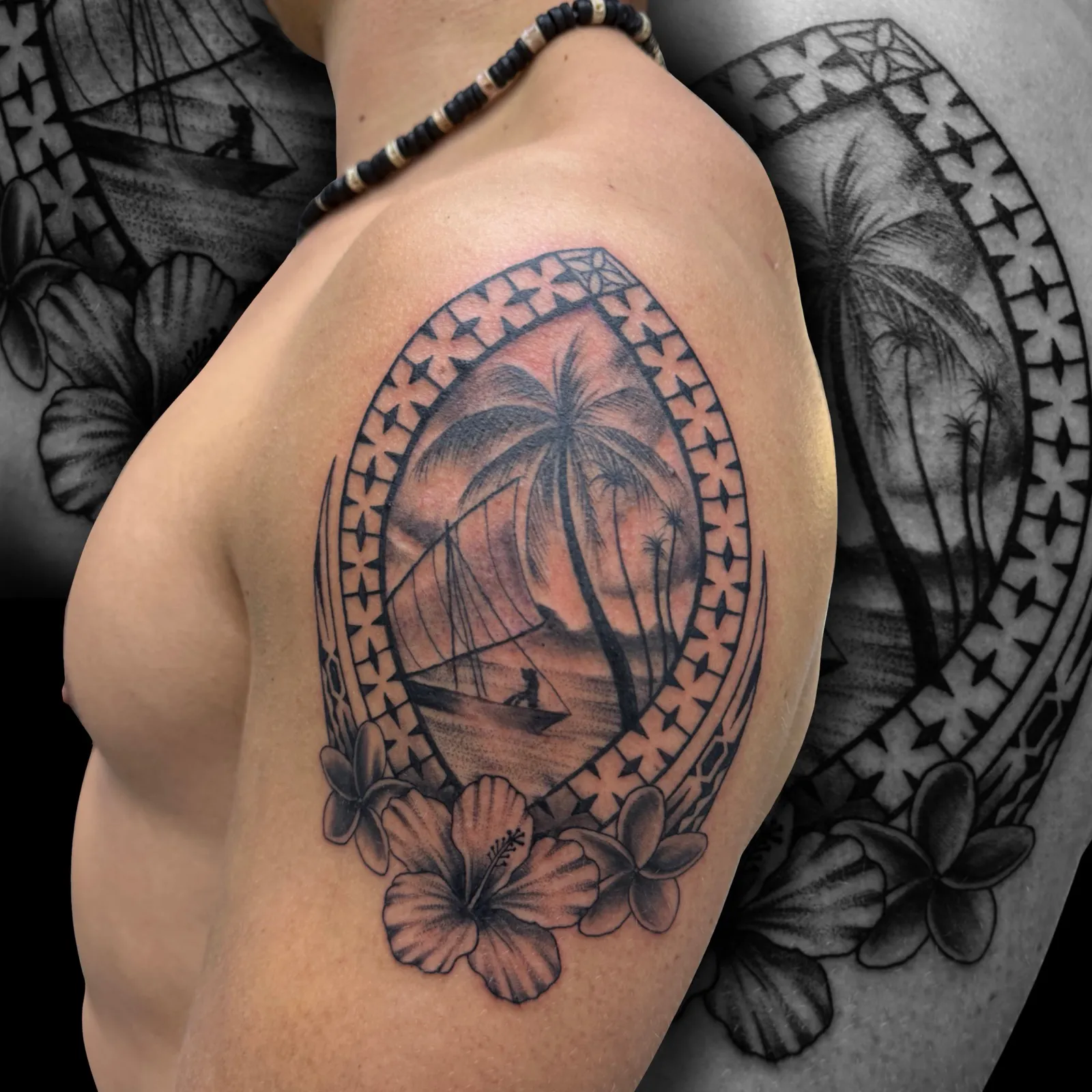
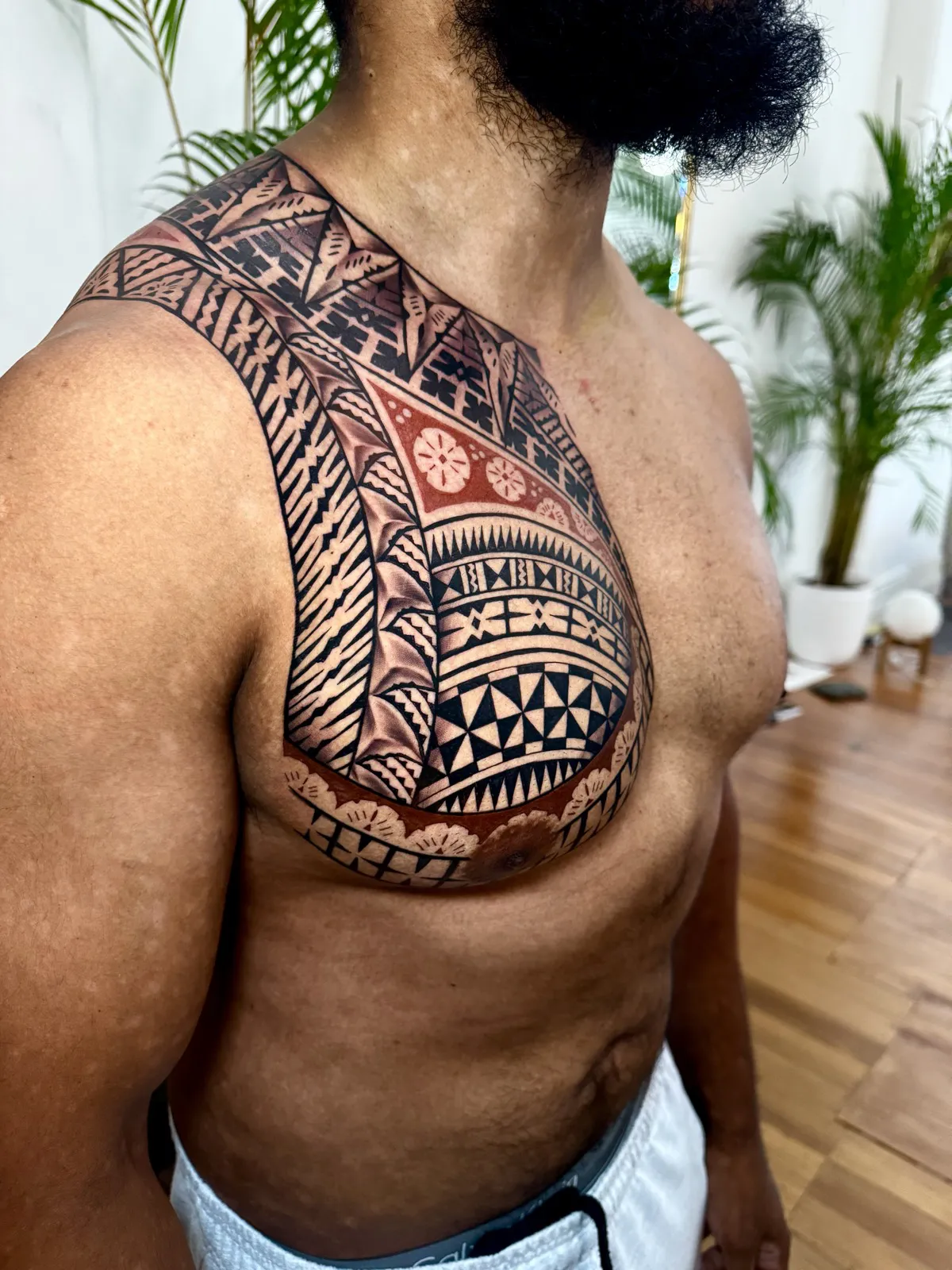
You'll notice the negative space in these. That's deliberate. Cramming every millimetre with pattern is a rookie move — the gaps are what let the bold blackwork read from across a room and what keep the piece clean as it ages over the years.
How a sleeve gets built across sessions
People are sometimes surprised a sleeve isn't one marathon sitting. It isn't, and it shouldn't be. Here's roughly how it goes.
1. The consult and the map
We sit down — free, no pressure — and talk about what the piece means to you. If you've got Pacific Island heritage, we start with your family, your island, your lineage. If you're drawn to the look without that connection, we talk honestly about how to honour the tradition rather than copy sacred patterns. Either way is a valid starting point. I cover the symbol side of this in detail in my Polynesian symbols and meanings guide — worth a read before you come in.
2. The outline session
We lay down the major bands and the skeleton of the composition. This is the longest single stage and it's where the structure of the whole sleeve gets locked in. Once the outline is healed, everything else builds on top of it.
3. Filling and detail
Subsequent sessions fill the blackwork, build texture into the patterns, and refine the detail. We work in chunks — a few hours at a time — and let each section heal before moving on. Rushing solid blackwork over un-healed skin is how you get patchy work, so I won't do it.
4. Healing between sessions
You need roughly 2 to 4 weeks between sessions so each area can settle. That spacing isn't me being slow — it's me protecting the result. A sleeve done properly takes months, and that's a feature, not a bug.
What it costs — honestly
Sydney pricing sits roughly between $150 and $250 an hour depending on the artist and studio. For Polynesian work specifically, here's a realistic guide for the inner west:
- Forearm band: around $600–$1,200, often one or two sessions
- Half sleeve: roughly $1,500–$3,500 across 2–4 sessions
- Full sleeve: $5,000+, sometimes well into five figures for a dense, detailed arm over many sittings
Those are honest ballparks, not a quote — the real number depends on size, density, and how many hours your specific design needs. I work on a $300 deposit that comes off your first session, and I'll give you a proper estimate at the consult once I've seen the arm. For the full picture on how I price Pacific work, the Polynesian tattoo Sydney page goes deeper.
Looking after a forearm piece
One honest warning, because the forearm is exposed: sun is the enemy of black ink. Once it's healed, sunscreen on that arm is non-negotiable if you want the blackwork to stay bold. I'll walk you through aftercare properly, but that's the one thing that wears Polynesian forearm work down fastest, and it's entirely avoidable.
Designing yours in Newtown
If you've got a forearm band or a half sleeve in your head, the best next step is just to talk it through. I'm at Memento Tattoo on King Street in Newtown, and Fijian and Polynesian work is what I come back to again and again — it's where my own roots are, and that shapes how I approach every piece.
Bring your ideas, your references, whatever's meaningful to you. We'll work out what fits your arm, what the piece should say, and how to build it across sessions so it lasts. Half the work happens in that conversation before any ink goes in — and getting placement right is genuinely half the result, which is why I wrote a whole separate guide on choosing size and placement.
Thinking about a Polynesian or Fijian half sleeve? Consultations are free — phone, video, or in person at Memento Tattoo in Newtown. Book a consultation, or see more healed work first in the portfolio. No pressure, no commitment — just an honest chat about whether it's the right piece for you.
Common questions
Answered before you ask
- How much does a Polynesian half sleeve cost in Sydney?
- As a realistic guide for inner-west Sydney, a Polynesian half sleeve runs roughly $1,500–$3,500 across 2–4 sessions, with hourly rates sitting around $150–$250. A forearm band is usually $600–$1,200, and a full sleeve starts around $5,000 and climbs with density and detail. The real figure depends on size, pattern density and the hours your specific design needs — I give a proper estimate at the free consult, and work on a $300 deposit that comes off your first session.
- How many sessions does a Polynesian sleeve take?
- A forearm band is often one or two sessions. A half sleeve is typically 2–4, and a full sleeve usually 4–8 or more, spread over months. We leave roughly 2–4 weeks between sessions so each area heals properly before building the next — rushing solid blackwork over un-healed skin is how you get patchy work.
- What's the difference between a forearm band, a half sleeve and a full sleeve?
- A forearm band wraps a defined section of the forearm — a cuff of pattern. A half sleeve covers either shoulder-to-elbow or elbow-to-wrist, giving room for a full composition. A full sleeve runs shoulder to wrist as one connected piece. If you might want more later, I design earlier stages so they extend cleanly into a full sleeve rather than looking stitched together.
- Do I need Pacific Island heritage to get a Polynesian tattoo?
- No — being drawn to the look is a valid starting point. If you have Pacific Island heritage, we start with your family, island and lineage. If you don't, we talk honestly about honouring the tradition with adapted elements rather than copying sacred patterns. Either way, the consult is where we get that right.
- Where can I get a Polynesian half sleeve done in Newtown?
- I tattoo Polynesian and Fijian work at Memento Tattoo on King Street in Newtown, inner-west Sydney. Consultations are free — phone, video or in person — and that conversation is where we map the piece to your arm before any ink goes in.